| |||||||||||||||||||||||||||||||||||||||||||||||
| |||||||||||||||||||||||||||||||||||||||||||||||
Showing posts with label myheritage. Show all posts
Showing posts with label myheritage. Show all posts
Saturday, November 10, 2018
Free Access to Military Records to Mark 100 Years Since the End of WWI
The following is from MyHeritage.


Tuesday, March 13, 2018
MyHeritage's FamilySearch Tree Sync (beta) for LDS Members
The following is from MyHeritage.
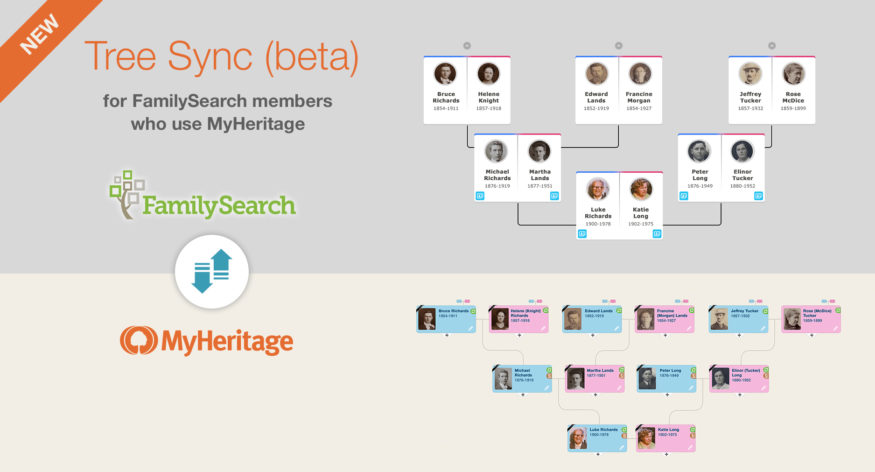
New FamilySearch Tree Sync (beta) allows FamilySearch users to synchronize their family trees with MyHeritage
New FamilySearch Tree Sync (beta) allows FamilySearch users to synchronize their family trees with MyHeritage
For the past 2.5 years, MyHeritage and FamilySearch engineers have been developing together a unique feature — FamilySearch Tree Sync — that allows members of the Church of Jesus Christ of Latter-day Saints (LDS) to easily and accurately import a portion of their tree from FamilySearch into MyHeritage, and then keep their MyHeritage and FamilySearch trees synchronized. This feature is now released in a limited beta, and volunteers who are LDS members are invited to try it out.
Learn more »
Saturday, March 10, 2018
MyHeritage Releases New Collections with 325 Million Historical Records
The following is from MyHeritage.

MyHeritage Releases New Collections with 325 Million Historical Records
Latest additions are the 1939 Register of England & Wales; a unique and innovatively structured U.S. yearbooks collection; and a collection of Canadian obituaries
TEL AVIV, Israel & LEHI, Utah--(BUSINESS WIRE)--MyHeritage, the leading global destination for family history and DNA testing, announced today the addition of three important historical records collections that provide value for family history enthusiasts worldwide.
Prepared on the eve of World War II, with 33 million searchable records, the 1939 Register is the most complete census-like collection for the population of England and Wales between 1911 and 1951. This is because the 1921 census of England and Wales is time-protected by privacy laws and will be available online only in 2022, the entire 1931 Census was destroyed by a fire, and no census was conducted in 1941. For each household member, the 1939 Register records name, gender, address, birth date, marital status, place of residence, and occupation. This collection is an extremely important resource for family historians and people with ancestors in England and Wales. The 1939 Register collection is not exclusive, but other than MyHeritage, it is currently available on only one other website. The initial collection on MyHeritage includes an index, without images.1939 Register of England & Wales
Of the 42 million records of individuals in this collection, 8.2 million records remain closed due to privacy protection requirements, and about 700,000 additional records appear without full names. Records are closed for those individuals who were born less than 100 years ago unless matched to a registered death record. These closed records will be made public and added to this online collection on a yearly basis going forward.
In December 2017, MyHeritage published an extensive collection of U.S. yearbooks with 36,207,173 pages in 253,429 yearbooks. This collection was a free-text collection allowing users to search by name or keyword. Not stopping there, MyHeritage engineers have been working for the past year to develop an unprecedented automated name index from this collection. The fruit of this work is now released as a separate collection named the U.S. Yearbooks Name Index, 1890–1979. The new collection is one of the largest collections of digitized U.S. yearbooks in existence, containing 289 million structured records. In the new collection, the names of the students and faculty members have been automatically extracted using name extraction technology. The personal photos in the yearbooks have been automatically detected and extracted using picture detection technology, and in many cases the names and the photos have been associated with each other using a third proprietary technology developed by MyHeritage. Finally, technology has been developed to automatically differentiate between students and faculty members, to determine the graduation class of each student and to calculate birth years.
All occurrences of the same name in each yearbook were consolidated into one record with references to the pages where the person is mentioned. The end result is a one-of-a-kind structured U.S. yearbook collection in which names can be searched accurately (with synonyms and translations, which is often not possible in free-text collections), as well as matched automatically to the family trees on MyHeritage using the company’s Record Matching technology. This makes U.S. yearbooks one of the most valuable genealogical resources for family historians today, and this treasure trove of information is available in this unique and highly accessible form only on MyHeritage. The records list the person’s name, school’s name and location, and likely residence based on the location of the school. Where possible, a personal photo is provided. For each person, full access to all applicable yearbook pages is provided. Additional work is being carried out to complete the association of names with photos, and this will be released as an update to this collection in the future.
A collection of 2 million records documenting obituaries and memorials from the 10 Canadian provinces, spanning mostly 1997-2017. It includes the name of the deceased, the date of death, the publication source including locality information, and the text of the obituary or memorial — in English or French depending on the source. When available, a photograph of the deceased is also included.
Summary
“The depth and diversity of these hundreds of millions of historical records is a blessing for people searching for information about their families,” said Russ Wilding, Chief Content Officer of MyHeritage. “Aside from the release of the collections themselves, we have invested much effort and demonstrated technological innovation to make it as simple as possible to glean useful genealogical information from these historical records.”
The three new collections are accessible through SuperSearch™, MyHeritage’s search engine for historical records, which now contains 8.8 billion historical records. Searching the collections is free. A subscription is required to view the records.
About MyHeritage
MyHeritage is the leading global destination for family history and DNA testing. As technology thought leaders, MyHeritage has transformed family history into an activity that is accessible and instantly rewarding. Its global user community enjoys access to a massive library of historical records, the most internationally diverse collection of family trees and groundbreaking search and matching technologies. MyHeritage DNA is a technologically advanced, affordable DNA test that reveals ethnic origins and previously unknown relatives. Launched a little more than a year ago, MyHeritage DNA has already amassed 1.25 million people in its database. Trusted by millions of families, MyHeritage provides an easy way to find new family members, discover ethnic origins, and to treasure family stories, past and present, for generations to come. MyHeritage is available in 42 languages. www.myheritage.com
MyHeritage Releases Chromosome Browser Upgrade
The following is from MyHeritage.

MyHeritage Releases Chromosome Browser Upgrade to Facilitate Better Exploration and Interpretation of DNA Matches
TEL AVIV, Israel & LEHI, Utah--(BUSINESS WIRE)--MyHeritage, the leading global destination for family history and DNA testing, announced today a major upgrade of its chromosome browser, making it easier for users to make the most of their DNA matches.
In January 2018, MyHeritage launched an initial version of the chromosome browser which showed shared DNA segments between a user and any one of his or her DNA Matches — people who are likely to be relatives because there are significant similarities between their DNA. The upgrade released today enhances the chromosome browser from supporting comparisons of one-to-one, to one-to-many. It is capable of showing shared segments between a user and up to seven DNA Matches concurrently. For each shared DNA segment, the user can review the genomic position of the segment and its size.A chromosome browser is a graphical tool that represents a person’s chromosomes. It visualizes DNA segments shared by two people who have matching DNA, that may originate from one or more shared ancestors. By studying those segments and testing the DNA of additional relatives, it is possible to determine who the segments originated from and understand the relationship path between the two people.
The upgraded chromosome browser is available for free, and it is unique in the DNA testing industry in supporting automatic triangulation: showing segments shared between multiple people that all match each other, increasing the likelihood that the group of people are descended from the same ancestor. It also provides download capabilities of shared DNA segment information. In addition, the company announced today a new, convenient ability to download a list of all of a person’s DNA matches.
“DNA testing, family trees and historical records integrate seamlessly on MyHeritage to facilitate exploration of one’s family history, via genetic genealogy,” said Gilad Japhet, MyHeritage Founder and CEO. “We have made it one of our goals to create the best platform in the industry for genetic genealogy. Today’s release is an important step in this direction. By iterating the product frequently and listening closely to our user community, we’re making it easier than ever for our users to find new relatives, which is one of the main benefits of genetic genealogy.”
The new chromosome browser is a free feature, available to all users who have taken the MyHeritage DNA test or have uploaded DNA data from another service to MyHeritage, which is free. Additional tools for genetic genealogy will be released by the company soon.
About MyHeritage
MyHeritage is the leading global destination for family history and DNA testing. As technology thought leaders, MyHeritage has transformed family history into an activity that is accessible and instantly rewarding. Its global user community enjoys access to a massive library of historical records, the most internationally diverse collection of family trees and groundbreaking search and matching technologies. MyHeritage DNA is a technologically advanced, affordable DNA test that reveals ethnic origins and previously unknown relatives. Launched a little more than a year ago, MyHeritage DNA has already amassed more than 1.25 million people in its database. Trusted by millions of families, MyHeritage provides an easy way to find new family members, discover ethnic origins, and to treasure family stories, past and present, for generations to come. MyHeritage is available in 42 languages. www.myheritage.com
MyHeritage Launches DNA Quest — a Major Pro Bono Initiative for Adoptees and Their Biological Families to Find Each Other via DNA Testing
The following is from MyHeritage.
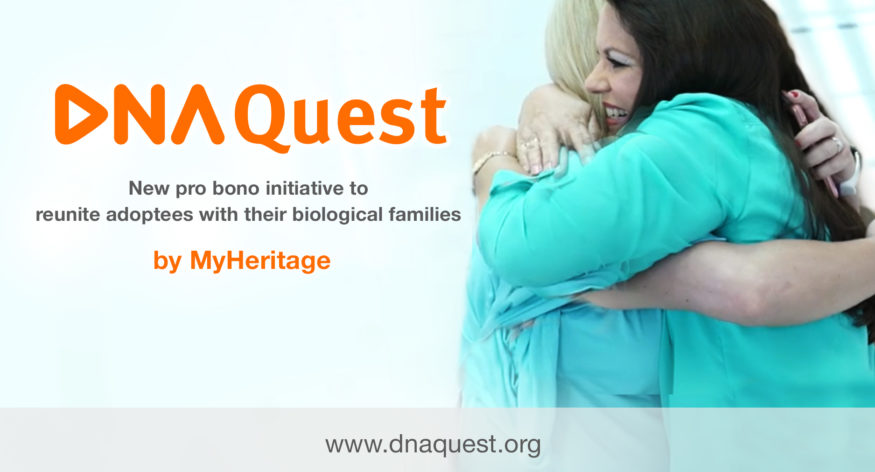
MyHeritage Launches DNA Quest — a Major Pro Bono Initiative for Adoptees and Their Biological Families to Find Each Other via DNA Testing
MyHeritage will distribute 15,000 DNA kits, worth over one million dollars, for free in the first phase of this initiative
TEL AVIV, Israel & LEHI, Utah--(BUSINESS WIRE)--MyHeritage, the leading global destination for family history and DNA testing, announced today the launch of a new pro bono initiative, DNA Quest, to help adoptees and their birth families reunite through genetic testing. As part of this initiative, MyHeritage will provide 15,000 MyHeritage DNA kits, worth more than one million dollars, for free, with free shipping, to eligible participants. Participation is open to adoptees seeking to find their biological family members, and to anyone looking for a family member who was placed for adoption. Preference will be given to people who are not able to afford genetic testing. The first phase of the initiative is open to USA residents, involving adoptions that took place in the USA. Application opens today on the project website, www.dnaquest.org, which includes detailed information about the initiative.
Many of the approximately 7 million adoptees living in the USA today are searching for their biological parents or siblings. The search is time-sensitive, because every year some of the people who are searching pass away, missing the opportunity to reunite. Currently, the main avenues for adoptees and their biological parents to find each other are adoption agencies, registries created for this purpose, and genetic testing. With formal adoption records being unavailable or difficult to obtain in most states, genetic genealogy opens new doors in the search for relatives, and MyHeritage believes everyone should be able to access this valuable technology.
To maximize the potential of this initiative to successfully reunite families, MyHeritage has set up an advisory board of top experts in the fields of genetic genealogy and adoption to guide and support this initiative on a voluntary basis. This alliance ensures the best possible professional support for participants, with each advisory board member bringing unique expertise. The advisory board includes: CeCe Moore, founder of The DNA Detectives; Blaine Bettinger, The Genetic Genealogist; Richard Weiss of DNA Adoption; Richard Hill, DNA Testing Adviser; Katharine Wall, founder of Adopted.com; Brianne Kirkpatrick, founder of Watershed DNA; Pamela Slaton, investigative genealogist; Leah Larkin, The DNA Geek; and Susan Friel-Williams, Vice President, American Adoption Congress.
DNA Quest is an expansion to the USA of another one of MyHeritage’s successful pro bono projects to reunite adoptees from the Israeli Yemenite community with their biological families. In that project, MyHeritage facilitated successful reunions between adoptees and their biological siblings, solving challenging cases where the protagonists were searching for each other without success for more than 60 years.
“We have a company culture of using our resources and technology for the greater good. In this spirit we’ve initiated several significant pro bono projects, such as returning looted assets from WWII to their rightful owners and documenting family histories and traditions of tribal peoples who lack access to modern technology. DNA Quest is a natural extension of these efforts,” said MyHeritage Founder and CEO Gilad Japhet, who conceived DNA Quest. “There is a great need for a project like this — to help adoptees find their biological families — and we are the right company to take it on. We’ve already successfully reunited many families and are confident that through this initiative, together with a wonderful alliance of top experts, we’ll be able to utilize the power of genetic genealogy to help many more.”
“Few things are more fulfilling than a life-changing adoptee-family reunion”, said CeCe Moore, founder of DNA Detectives, the largest group on Facebook that brings together volunteers with genetic genealogy and searching experience, and those seeking biological family. “I’m very excited to be a member of the DNA Quest advisory board and look forward to assisting participants in finding the lost loved ones for whom they are yearning."
There are already more than 1.25 million people in the MyHeritage DNA database — one of the fastest growing among the major DNA companies. Additionally, MyHeritage is unique among the top three DNA companies to offer the option to upload DNA results from other test providers, and this is available for free. The company is uniquely positioned to reunite families and has indeed facilitated many emotional success stories, with more taking place in every passing day.
Adoptees and family members searching for their biological relatives can apply for a free MyHeritage DNA kit at DNAQuest.org through April 30, 2018. Participants will be selected, and their free DNA kits will be shipped to them by the end of May 2018. Results are expected as early as July 2018.
Those who have already taken a DNA test with another company can upload their DNA data to MyHeritage for free and participate in this initiative as well.
The privacy of all applicants and participants will be strictly enforced. The DNA is owned by the participants and not by MyHeritage. The company has never sold genetic data and has pledged to never do so in the future without users’ explicit consent. DNA Quest is a pro bono project without gotchas or caveats.
About MyHeritage
MyHeritage is the leading global destination for family history and DNA testing. As technology thought leaders, MyHeritage has transformed family history into an activity that is accessible and instantly rewarding. Its global user community enjoys access to a massive database of historical records, the most internationally diverse collection of family trees and groundbreaking search and matching technologies. Launched in November 2016, MyHeritage DNA is a technologically advanced, affordable DNA test that reveals ethnic origins and previously unknown relatives. Trusted by millions of families, MyHeritage provides an easy way to find new family members, discover ethnic origins, and to treasure family stories, past and present, for generations to come. MyHeritage is available in 42 languages. For more detail, visit www.myheritage.com. DNA Quest is available on www.dnaquest.org.
Friday, November 24, 2017
MyHeritage DNA Black Friday Sale Ends 27 Nov 2017
The following is from MyHeritage.


Through Monday only, MyHeritage DNA kits will be available for $49 instead of $99. That's a whopping 50% off! We're also offering FREE shipping on orders of 3 kits or more.
We think this would be a great opportunity to share this special offer with your family and friends.
Why choose MyHeritage DNA?
Why choose MyHeritage DNA?
- MyHeritage DNA covers 42 ethnic regions with percentages — more than any other major DNA vendor
- The fastest processing time — only 3-4 weeks
- International database improving your chances of finding relatives around the world
- Fully integrated with family tree tools and historical records to expand your family research
MyHeritage DNA kits make for a truly special and unique holiday gift for your family. So hurry up and order kits for yourself and your family at this amazing sale price!
Enjoy,
Enjoy,
Daniel HorowitzGenealogy Expert
MyHeritage: New York Newspapers and New York Marriage License Records
The following is from MyHeritage.
Now Online: New York Newspapers and New York Marriage License Records
I'm excited to let you know that we’ve added two significant New York collections: New York City Marriage License Index, 1908–1929 and New York Newspapers, 1806–2007 to SuperSearch™.
These collections are valuable to anyone looking to uncover new information about their ancestors, especially those who had strong ties to New York.
The New York Newspapers, 1806–2007 collection includes more than 1.9 million pages of 56 newspapers published in different cities and towns in New York State, dating back to the early 1800s. Historical information is included on celebrities and important events in the 19th–20th centuries.
The New York City Marriage License Index, 1908–1929 collection is an index to marriage licenses filed at the New York City Clerk Offices from the five boroughs of New York from 1908–1929 and includes more than 1.5 million marriage license records.
Searching these collections is free. A subscription is required to view records and scanned images, and to access Record Matches.
Please read our blog post for more details about the two New York collections. Feel free to explore the collections and let us know what you discover.
MyHeritage Adds Significant Collection of New York Immigration Records with Unique Content
The following is from MyHeritage.
MyHeritage Adds Significant Collection of New York Immigration Records with Unique Content
90 million records from the Ellis Island and Other New York Passenger Lists collection bring to light the stories of millions of immigrations, arrivals and visits to America spanning 138 years
TEL AVIV, Israel & LEHI, Utah, November 2, 2017 – MyHeritage, the leading international family history and DNA company, announced today the addition of the Ellis Island and Other New York Passenger Lists 1820-1957 collection to SuperSearch™, the company’s global search engine containing more than 8.25 billion historical records. The records are of major significance for anyone looking to trace their immigrant ancestors’ arrival in America, and include names, dates, countries of origin, addresses of family members and friends, occupations, and physical descriptions, among many other details.
The passenger manifests are an unparalleled source of information spanning key years of immigration from all over the world, including those entering the United States as refugees during the First and Second World Wars. The records include millions of entries via Ellis Island, which opened its doors on January 1, 1892. The first 72 years of the collection pre-date Ellis Island; Prior to the establishment of Ellis Island, the primary immigration station in New York City was Castle Garden, which opened in 1855, and before then, immigrants were received at several piers across the city. Towards the end of the timeframe, in the 1940s and 1950s, advancements in transportation methods are noticeable as records begin to include those who arrived via airplane to various airports in and around the city. The plethora of information in the records is expected to invigorate family histories, adding previously unknown stories of how family members uprooted their lives, and replanted them in the United States.
As of 1897, immigration officials began asking those entering the United States for the name and address of the relative or friend whom they are joining in the USA, and in 1907 they began asking for the name and address of their closest relative or friend in their home country. The responses to these supplemental questions, that have been filled in the passenger manifests, have now been indexed by MyHeritage for the very first time, yielding an additional 26.6 million names in the Ellis Island and Other New York Passenger Lists collection on MyHeritage. These passenger manifests have been digitized by other organizations in the past, but the answers to these vital supplemental questions have never been indexed — until now. Furthermore, many of the passenger manifests span two pages, and a common omission for genealogists has been to locate the first page and miss the existence of the second. MyHeritage has solved this problem for the first time by stitching the double pages into single document images, ensuring that users do not miss information again.
Many historical figures of interest are found among these records, including Albert Einstein (who arrived in the US on October 17, 1933), former U.S. Secretary of State Madeline Albright (arrived November 11, 1948) and Charlie Chaplin (arrived October 1912). Composer and songwriter Irving Berlin who moved to the U.S. in 1903, appears on several manifests arriving from different places in Europe.
Users with family trees on MyHeritage will immediately benefit from Record Matching technology that automatically reveals new information about their ancestors who appear in these records.
“The Ellis Island and Other New York Passenger Lists 1820-1957 collection is a major asset on MyHeritage is a major asset for family history enthusiasts,” said Russ Wilding, Chief Content Officer at MyHeritage. “When we digitized this collection we employed out-of-the-box thinking to cover important aspects that were overlooked by others in the past. This makes this collection on MyHeritage the most complete and useful of its kind.”
MyHeritage is working to add additional immigration records into the collection from other port cities from around the United States, as well as several important Canadian border crossings, in the near future.
Searching the Ellis Island and Other New York Passenger Lists collection is free. A subscription is required to view records and scanned images and to access Record Matches.
About MyHeritage
MyHeritage is the leading global destination for family history and DNA. As technology thought leaders, MyHeritage has transformed family history into an activity that is accessible and instantly rewarding. Its global user community enjoys access to a massive library of historical records, the most internationally diverse collection of family trees and groundbreaking search and matching technologies. Through MyHeritage DNA, the company offers technologically advanced, affordable DNA tests that reveal users' ethnic origins and previously unknown relatives. Trusted by millions of families, MyHeritage provides an easy way to find new family members, discover ethnic origins, and to share family stories, past and present, and to treasure them for generations to come. MyHeritage is available in 42 languages. www.myheritage.com
Saturday, February 04, 2017
MyHeritage News, new DNA Feature & Discoveries Pages
The following is from MyHeritage.

We’ve just introduced the new Discoveries pages on MyHeritage.
The Discoveries pages provide a unified experience for all matches, organizing them into two main pages: Matches by People and Matches by Source. Now you can look at all matches that were found for a particular individual in your family tree, or all matches found in a particular collection of historical records or matching family tree. Whatever you choose to use, the new pages combine Smart Matches (matches with trees) and Record Matches (matches with records) into the same unified and consistent interface.
We also now display the new information that each match provides, and matches are arranged by the value that they add to your family tree, so that those matches that add the most value are listed first.
This saves you time and allows you to focus on the most valuable matches. You can easily save all new and improved information to your family tree.
MyHeritage is known throughout the industry for it's matching technologies, and they have just gotten even better with a great new user interface. The new pages are easier to use, more intuitive and much faster than the previous layout.
To learn more about the Discoveries page visit: https://blog.myheritage.co
| |||||

Subscribe to:
Posts (Atom)